
Launching a great product and successfully bringing it to market are two very different things.
You've invested in product development, packaging, branding, distribution, and perhaps even secured your first major retail partner. But how do you get people to care? How do you build credibility as a newcomer, stand out in an increasingly crowded category, and create momentum that extends well beyond launch day?
That's where public relations comes in.
A successful product launch PR strategy combines compelling storytelling, targeted media relations, strategic product sampling, and coordinated marketing efforts to build awareness, establish credibility, and support commercial growth.
At Startr Co., a strategic communications agency specializing in scaling next-generation consumer brands, we've helped emerging brands enter new categories, launch into national retailers, introduce product innovations, and challenge established industry players.
While no two product launches are alike, the most successful ones have something in common: PR is treated as an integral part of the go-to-market strategy, not an afterthought.
Here's our step-by-step guide to building a product launch PR campaign that delivers both immediate impact and long-term brand value.
Why PR Should Be Part of Every Product Launch Strategy
Advertising allows you to tell consumers why your product matters. Earned media gives an independent voice a reason to tell them.
For startups and emerging brands without decades of brand recognition or massive marketing budgets, credible third-party validation can be particularly powerful.
A strategic product launch PR campaign can help brands:
Build awareness and credibility with target consumers
Establish meaningful differentiation within a competitive category
Educate audiences about a new product, ingredient, technology, or solution
Generate interest among retail buyers, distributors, and potential investors
Drive product discovery, trial, and purchase consideration
Strengthen brand visibility across traditional search engines and AI-powered discovery platforms
Create credible content that can be leveraged across marketing and sales channels
Perhaps most importantly, PR can help an emerging brand establish what it wants to be known for before the market defines it.
A successful launch isn't simply about getting your product in the press. It's about establishing a narrative that gives your brand relevance long after the initial announcement.
When Should Startups Begin Planning Their Product Launch PR Campaigns?
Ideally, startups and emerging brands should begin planning their product launch PR campaigns three to six months before their anticipated launch date. The appropriate timeline will depend on the complexity of the product, distribution strategy, target media, and overall business objectives.
Media operates on a variety of editorial timelines. While some digital outlets can turn around a story in a matter of days, print publications, broadcast segments, comprehensive product reviews, and larger editorial features can require months of advance planning.
Recommended Product Launch PR Timeline
Three to six months before launch
Establish campaign objectives, develop brand positioning and messaging, identify newsworthy narratives, and begin building the media relations strategy. Consider engaging a PR agency at this stage to inform broader go-to-market decisions, generate long lead media opportunities, and help build out any larger programs (e.g., content creators and events/activations).
One to two months before launch
Develop press materials, identify product sampling opportunities, and coordinate with retail, marketing, and influencer partners.
Four to eight weeks before launch
Expand targeted media outreach, distribute product samples as available, facilitate interviews and media desksides, and build interest around the upcoming announcement.
Launch week
Execute timely media outreach, manage incoming opportunities, amplify secured coverage, and coordinate with broader marketing and retail initiatives.
One to three months after launch and beyond
Continue pitching fresh angles, leverage early sales and distribution milestones, pursue product reviews, and build sustained brand visibility.
Can a successful PR campaign be executed on a shorter timeline? Absolutely. Some of our most impactful media placements have come from moving quickly on exceptionally compelling stories. But compressed timelines limit the universe of opportunities available to a brand.
The earlier PR is brought into the conversation, the more strategically it can contribute to the launch.
Develop a Compelling Brand Story and Product Messaging
One of the biggest mistakes emerging brands make is assuming that because a product is new, it's inherently newsworthy.
Newness alone is rarely enough.
Journalists are looking for stories that are relevant, differentiated, timely, and meaningful to their audiences. Your product launch PR strategy needs to connect what you're launching with a bigger conversation.
Before beginning media outreach, brands should be able to clearly answer:
What problem does this product solve?
What makes it meaningfully different from what's already available?
Why is this product particularly relevant right now?
What consumer behavior, cultural shift, or industry trend does it address?
What makes the founders uniquely qualified to bring this product to market?
What evidence supports the brand's claims and differentiation?
A compelling PR strategy should establish multiple storytelling opportunities rather than rely on a single product launch announcement.
For example, an emerging better-for-you snack brand might have opportunities to tell stories around ingredient innovation, changing consumer preferences, the founder's entrepreneurial journey, category disruption, and retail expansion.
Each narrative creates a different entry point for media and extends the life of the launch campaign.
Build a Strong Foundation of Press Materials
Once the brand's positioning and key narratives are established, develop the materials journalists will need to accurately and effectively tell its story.
These may include:
A brand backgrounder and product fact sheet
Founder biographies and approved talking points
High-resolution product and lifestyle photography
Product pricing, availability, and retailer information
Supporting research, certifications, or substantiated product claims
A press release, when warranted by the significance of the announcement
Clear, consistent messaging across these materials, the brand's website, and other consumer-facing channels can also support how search engines and AI platforms understand and represent the brand.
At Startr Co., we don't just ask what a brand is launching. We ask what conversation it has the opportunity to own.
Build a Pre-Launch Media Relations Strategy
Effective media relations is about far more than distributing a press release.
A strategic pre-launch media relations plan identifies the right journalists, publications, and platforms based on the brand's business objectives, target audiences, and most compelling stories.
Depending on the product, this might include:
National consumer and lifestyle publications
Industry-specific trade media
Business and entrepreneurial outlets
Shopping and commerce editors
Health, wellness, or nutrition journalists
Broadcast television and podcasts
Relevant newsletters and independent editorial platforms
The key is understanding that different media verticals require different stories.
A grocery trade publication may be interested in how a product addresses an unmet category need. A business journalist may be more compelled by the founder's growth strategy. A shopping editor may want to know how the product performs, what it costs, and where consumers can buy it.
For consumer brands, particularly direct-to-consumer (DTC) consumer packaged goods (CPG), affiliate marketing capabilities should also be considered early. Many commerce editors work within editorial models that incorporate affiliate revenue. Having an affiliate program in place can expand the opportunities available to a brand, though it does not guarantee coverage.
For particularly newsworthy launches, an exclusive or embargoed media strategy may also be appropriate, giving select journalists advance access to the news and sufficient time to develop more substantial coverage.
Personalized outreach, strong editorial instincts, established media relationships, and persistent follow-through are what turn a product announcement into a broader storytelling opportunity.
Incorporate Product Sampling, Media Desksides, and Influencer Outreach
For consumer brands, experiencing a product firsthand can be one of the most persuasive components of a product launch PR campaign.
It's difficult to communicate exceptional taste, an innovative texture, superior functionality, or a unique user experience through a pitch alone.
Strategic Product Sampling
Product sampling puts products directly into the hands of relevant journalists, editors, and creators. Rather than sending hundreds of unsolicited packages, brands should prioritize thoughtful, targeted sampling that aligns with recipient interests and editorial opportunities.
Samples should be accompanied by concise, useful information that makes it easy to understand the product's differentiation, pricing, and availability.
Brands should also account for the logistics of sampling, including inventory, shipping, perishability, and the availability of finished or pre-production products ahead of launch.
Media Desksides and Product Demonstrations
Media desksides are individual or small-group meetings with journalists designed to introduce a brand, showcase products, facilitate tastings or demonstrations, and establish more meaningful relationships.
Whether conducted in person or virtually, desksides can be particularly valuable when a product requires education, offers a highly differentiated experience, or benefits from direct access to a founder or expert.
For emerging food and beverage, wellness, pet, tech, and lifestyle brands, these interactions can help bring a product's differentiation to life in ways that written materials simply cannot.
Influencer Outreach and Product Seeding
A complementary influencer strategy can help generate awareness, authentic product experiences, social proof and content around a launch.
Depending on campaign objectives and budget, brands may pursue organic product seeding, paid creator partnerships, or a combination of both.
The most effective programs prioritize audience relevance and genuine brand alignment over follower count alone. They also account for where consumers can purchase the product, particularly when a launch is tied to a specific retail partner.
While media relations and influencer marketing serve different purposes, coordinating the two can create multiple touchpoints for consumers discovering a new product.
Coordinate Your Product Launch With Earned Media Coverage
PR should never operate in a silo.
The strongest product launches happen when public relations, social media, paid advertising, influencer marketing, e-commerce, and retail initiatives work together.
Before launch, PR teams should have visibility into:
Confirmed product availability and distribution
Retailer announcements and promotional calendars
Website and e-commerce readiness
Paid media and influencer campaigns
Inventory and fulfillment capabilities
Founder and executive availability
Potential partnerships, events, and other marketing initiatives
Generating significant consumer interest before a product is readily available can mean missing valuable opportunities to convert awareness into sales.
Conversely, waiting until a product is already on shelves to begin thinking about PR can mean missing some of the most compelling storytelling opportunities associated with its debut.
Can You Guarantee Media Coverage on Launch Day?
No. Earned media coverage is determined by independent editorial decisions and timelines.
While an experienced PR team can strategically work toward a launch date, media coverage cannot be guaranteed for a specific day. Even with immediate editorial interest, journalists may need time to evaluate products, conduct interviews, and move stories through their editorial processes.
In fact, some of the most valuable coverage may come weeks or months after a product officially launches, when consumer feedback, sales performance, or other proof points give journalists an even more compelling story to tell.
Think of launch day as the beginning of your brand's public story, not the deadline for telling it.
Understand How Public Relations Supports Sales and Retail Growth
One of the most overlooked aspects of product launch PR is that consumers aren't the only audience that matters.
For emerging CPG brands, retail buyers are customers, too.
Credible media coverage can help demonstrate that a brand is relevant, differentiated, and generating interest in the marketplace. It can strengthen retailer presentations, support sell-in conversations, and help brands build credibility when pursuing new distribution opportunities.
PR doesn't just support retail growth. Retail growth can also fuel PR.
PR in Action: How Backflip Breakfast Turned Retail Momentum Into National Media Coverage
When Backflip Breakfast launched at Target in July 2026, the emerging cereal brand sold nearly 500,000 units in its first 60 days and subsequently reached the No. 2 cereal brand position at the retailer.
At Startr Co., we worked with the Backflip team to realize the opportunity to turn an impressive retail milestone into a much bigger brand story.
Rather than simply pitching another new cereal, we positioned Backflip as an emerging challenger gaining significant traction in a category long dominated by legacy brands.
Just 13 days after an initial phone conversation about the opportunity, a story appeared in Inc., bringing Backflip's breakout success to a national audience (for more on this Backflip success story, check out our CEO on Hummingbirds Cart Culture).
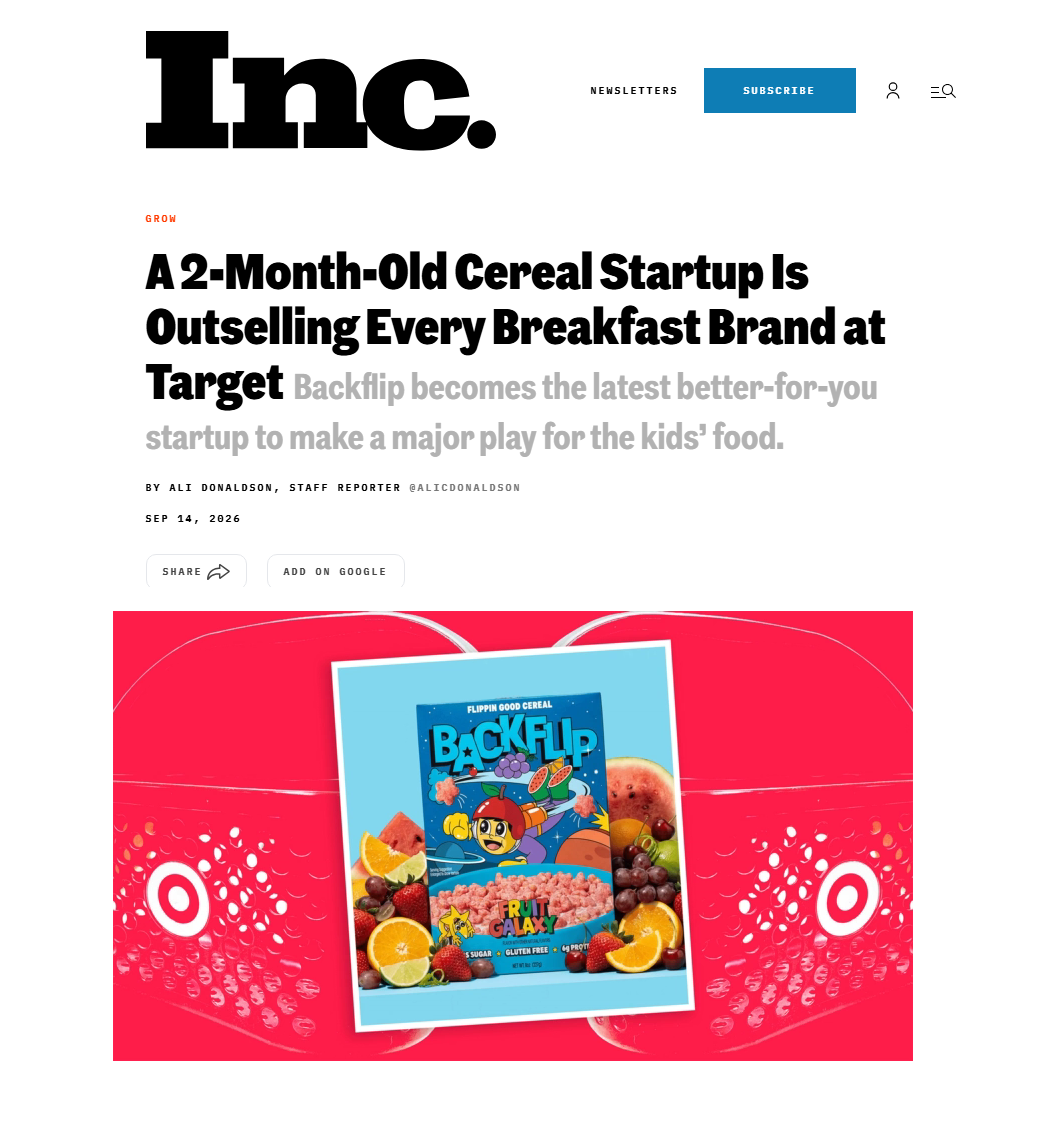
The coverage served a purpose well beyond consumer awareness. It provided credible third-party validation that Backflip could leverage in conversations with retail buyers, prospective business partners, and other industry stakeholders.
The takeaway for emerging brands? Don't underestimate the newsworthiness of what's happening within your own business. Sales velocity, retailer performance, repeat purchase rates, and distribution milestones can all become compelling media stories when placed in the right context.
It's also a powerful example of why PR shouldn't end on launch day. Sometimes, the biggest story is what happens next.
Extend the Value of Every Media Placement
A single meaningful media placement can be leveraged across:
Retail buyer presentations and sell-in materials
Investor presentations and fundraising conversations
Paid advertising, subject to applicable usage rights
Email marketing and e-commerce
Organic social media
Retailer marketing programs
Future media outreach
The value of a media placement doesn't necessarily end on the day it's published. When strategically leveraged, earned media becomes a business asset that can continue delivering value over time.
How PR Supports AI Visibility and Product Discovery
Public relations is also becoming increasingly important to how consumers discover products through AI-powered platforms such as ChatGPT, Google AI Overviews, Gemini and Perplexity.
Rather than simply searching for a product category, consumers can ask detailed, conversational questions:
What are the best high-protein cereals for breakfast?
Which better-for-you snacks actually taste good?
What are the most innovative skincare brands for sensitive skin?
Which emerging food brands are available at Target?
The answers generated by these platforms can be informed by a variety of sources, including credible editorial coverage, expert recommendations, product reviews, and publicly available brand information.
For emerging brands, building a credible editorial footprint and establishing clear, consistent brand associations early can support discoverability well beyond the initial launch.
This is where PR intersects with search engine optimization (SEO) and generative engine optimization (GEO), the practice of improving a brand's visibility within AI-generated answers and recommendations.
While no PR campaign can guarantee inclusion in AI-generated responses, strategically earned media can contribute to the broader information ecosystem these platforms draw from.
At Startr Co., we consider AI visibility alongside traditional media relations, identifying opportunities to build the relevance, clarity, and third-party credibility that can support brand discovery across both established and emerging platforms.
Measure the Success of Your Product Launch PR Campaign
Successful PR measurement starts with understanding what the business is trying to accomplish.
A startup launching exclusively through its own e-commerce website may have very different objectives from a brand introducing a new product across thousands of retail locations.
While the number and type of media placements is one indicator of campaign performance, there are other ways to measure of success (and optimize!).
Meaningful product launch PR metrics include:
Quality and relevance of media coverage: Is the brand appearing in outlets that reach its most important audiences, including consumers, buyers, and other business stakeholders?
Message penetration: Are the brand's key differentiators, product benefits, and intended narratives coming through in coverage?
Share of voice: Is the brand becoming a more prominent part of the media conversation relative to its competitors?
Consumer discovery and engagement: Is coverage contributing to website traffic, branded search, social engagement, or product interest?
Commerce performance: Where measurable, is coverage generating affiliate revenue, referral traffic, or conversions?
Retail impact: Is earned media supporting buyer conversations, distribution opportunities, or retailer confidence? Is there evidence of changes in sales velocity following significant coverage?
AI visibility: Is the brand appearing more frequently or accurately in relevant AI-generated answers, category comparisons, and product recommendations?
Long-term editorial value: Is coverage continuing to drive discovery, provide credibility, and create new opportunities over time?
Whenever possible, establish benchmarks before launching a PR campaign. Understanding the brand's existing media footprint, branded search activity, competitive share of voice, and AI visibility can help create a more meaningful picture of progress. At Startr Co., we review our clients’ AI visibility upon starting work to set a benchmark for success. We then optimize and work towards more and better results.
It's equally important to distinguish between correlation and attribution. Changes in sales, website traffic, or search activity are often influenced by multiple marketing initiatives happening simultaneously, and are not the barometer for a successful PR campaign.
Not every media placement will result in an immediate, directly attributable sale. PR often influences multiple stages of the customer journey, and its impact can be cumulative.
A strong campaign should be evaluated not only by what happens during launch week, but by the momentum, credibility, and opportunities it creates in the months that follow.
Know When to Hire a PR Agency for Your Product Launch
For early-stage brands, determining when to invest in a PR agency is an important business decision.
Not every startup needs an agency immediately. However, when a brand has a differentiated product, a clear path to purchase, and an opportunity to meaningfully compete within its category, experienced PR support can be a valuable investment.
It may be time to hire a product launch PR agency if:
You're preparing for a significant product or brand launch
You've secured a major retail partnership or distribution opportunity
You're entering a highly competitive category and need to establish differentiation
Your internal team lacks the media relationships, expertise, or bandwidth to execute a comprehensive campaign
You're investing in other marketing channels and want earned media to complement those efforts
You're looking to build credibility with consumers, retail buyers, and investors
You're interested in establishing greater visibility across traditional media, search engines, and AI-powered discovery platforms.
What Should Startups Look for in a Product Launch PR Agency?
When evaluating PR agencies, look beyond impressive media logos.
Consider the agency's experience launching brands at a similar stage of growth, understanding of your category, ability to think strategically about your business, and approach to campaign measurement.
For consumer brands, an agency with experience in retail, e-commerce, affiliate PR, and emerging consumer discovery behaviors can bring valuable perspective to a launch.
Ask prospective agency partners how they would differentiate your brand, which audiences they would prioritize, how they would sustain momentum beyond launch day, and how they would define success.
The right PR partner should challenge your thinking, identify opportunities you haven't considered, and understand how communications can contribute to your broader business objectives.
Frequently Asked Questions About PR for Product Launches
What is product launch PR?
Product launch PR is the strategic use of public relations to introduce a new product to the market, generate awareness, establish credibility, and drive interest among consumers, media, retail buyers, and other relevant audiences. It typically includes messaging development, media relations, product sampling, founder storytelling, and coordinated communications efforts.
How much does PR for a product launch cost?
The cost of product launch PR varies depending on the scope of work, campaign duration, target audiences, agency expertise, and supporting activities. Brands should account for agency fees as well as potential expenses related to product sampling, shipping, events, influencer partnerships, and paid editorial opportunities.
Rather than choosing a PR budget in isolation, consider the significance of the launch, overall marketing investment, and role earned media is expected to play in achieving business objectives.
How long should a product launch PR campaign last?
For many emerging consumer brands, a three- to six-month campaign is a reasonable starting point, though the ideal duration depends on the product, launch timeline, and business objectives.
Brands looking to build sustained awareness, expand distribution, and establish category authority may benefit from an ongoing PR strategy rather than a standalone launch campaign.
Do you need a press release to launch a new product?
Yes and no. A press release can be useful when a launch represents significant innovation, a major business milestone, or important retail expansion. However, personalized media outreach built around compelling, relevant story angles is often more valuable than distributing a generic product announcement.
The most effective product launch PR strategy prioritizes newsworthiness over the format used to communicate the news.
Can PR help a startup secure retail distribution?
PR can support retail distribution efforts by building brand credibility, demonstrating consumer relevance, and providing third-party validation that strengthens buyer conversations.
While media coverage alone does not guarantee retail placement, it can be a valuable complement to strong sales performance, category insights, product differentiation, and an effective retail sales strategy.
How does PR differ from advertising for a product launch?
Advertising involves paying for placement and controlling the message. Earned media involves securing independent editorial coverage through newsworthy storytelling, media relationships, and strategic outreach.
Both can play important roles in a product launch. Advertising provides greater control over timing, targeting, and messaging, while earned media offers independent perspectives that can strengthen brand credibility and trust.
Can PR improve a brand's visibility in AI search?
Yes, PR can help support AI visibility by building a credible body of publicly available third-party information about a brand. Relevant editorial coverage, product reviews, expert recommendations, and consistent brand messaging can contribute to the sources AI platforms may reference when generating answers.
However, AI visibility is influenced by multiple factors, and earned media coverage does not guarantee that a brand will appear in any particular AI-generated response.
A Successful Product Launch Is Just the Beginning
The best product launch PR campaigns do more than generate a moment of attention. They establish a foundation for sustained brand growth.
A launch creates an opportunity to introduce your product, define your brand's place in the market, and begin building the credibility that will support future innovations, retail expansion, and business milestones.
At Startr Co., we specialize in strategic communications for next-generation brands. With offices in Los Angeles and New York, we work with ambitious startups, emerging consumer brands, and established category challengers across food and beverage, wellness, pet, tech, toy, lifestyle, and beyond.
From product launches and national retail debuts to brand-building campaigns and AI visibility strategies, we help brands turn meaningful business moments into compelling stories that reach the audiences that matter most.
Launching something worth talking about? Let's make sure the right people are listening.
Connect with Startr Co. to discuss your product launch PR strategy.
Founded in 2016 and headquartered in Los Angeles and New York City, Startr Co. is a strategic communications agency that specializes in scaling next-generation brands. With big-brand experience and deep industry connections, the agency's approach is collaborative, transparent, and grounded in where a client's business is today, so it can lead and shape tomorrow. Over the past decade, Startr Co. has partnered with innovative and recognizable brands including Seven Sundays, GHOST, Our Home (Popchips, Pop Secret, Good Health), GOODLES, SmartSweets, Solely, Walker's Shortbread, La Terra Fina, Learning Resources Brands (Learning Resources, Educational Insights, hand2mind, Brightkins), Fera Pets, Flame Broiler, The Little Gym, and Flight Adventure Park, delivering campaigns that combine creativity, strategy, and measurable impact.